EN
EN PT
PT

 EN
EN
 PT
PT
A programme to regulate emotions and promote mindful behaviour and social skills
Product: Book
Trim size in cm: 17x24cm
Pages: 208
ISBN: 9788859045472
Publication date: 01/05/2026
REQUEST A SAMPLE OR MORE INFORMATION
Aimed at children with ADHD, including those with co-occurring Autism Spectrum Disorder (ASD), this volume is designed to provide a practical tool for addressing complex situations characterised by impulsivity, difficulties in emotional regulation and risk behaviours.
The programme is structured into 25 weekly group sessions, combined with individual work, guiding children in the development of key skills for everyday life. The main areas of intervention include:
Activities are presented in a clear and detailed way, with numerous ready-to-use worksheets that support implementation in both clinical and educational settings.
Introduction to the Programme
Chapter 1 - Neurodevelopmental Disorders
Chapter 2 - Executive Functions and Neurodivergence
Chapter 3 - Tools for Neurodivergence
Chapter 4 - Programme Structure
Sessions
Session 1 Becoming Familiar with the New Experience
Session 2 Making Decisions as a Group
Session 3 Personal Values
Session 4 Internal Obstacles
Session 5 Mindfulness
Session 6 Awareness of the Here and Now
Session 7 Mindful Listening
Session 8 Mindful Observation
Session 9 Emotional Self-Regulation
Session 10 Emotional Impulsivity
Session 11 Body Awareness
Session 12 Reviewing the Journey
Session 13 Internal Dialogue and Self-Regulation
Session 14 Mindful Actions
Session 15 Assertiveness Skills
Session 16 Taking Different Perspectives
Session 17 Perspective Taking in Everyday Life
Session 18 Problem Solving
Session 19 Problem Solving in Everyday Life
Session 20 Let’s Make a Film
Session 21 … Action!
Session 22 Strengths
Session 23 Social Skills
Session 24 The Journey We Have Taken Together
Session 25 … Celebration!
Additional Activities
Activities to Strengthen Executive Functions
Bibliography

It is well known that children with high levels of aggressive behavior, hyperactivity and behaviour problems create a serious management problem in the school context and interfere with the development of peer learning. Coping Power was created as a model of intervention and treatment, developed for children and preadolescents with aggression problems and for children with an oppositional defiant disorder or conduct disorder diagnosis. Today, the Coping Power School model consists of a structured course, integrated into daily teaching, which allows children and preadolescents to enhance their emotional-relational and anger management skills while the curriculum objectives are being met. Today, Coping Power can be applied in disadvantaged contexts, both in group and individual settings, in a school or extra-curricular environment.
The volumes dedicated to Coping Power offer a starting point for managing relational problems and promoting prosocial behaviours respectively in nursery school, pre-school, primary school, and secondary school.
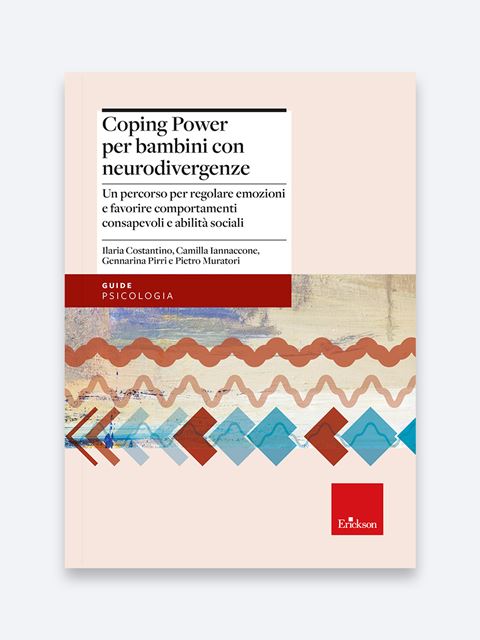
COPING POWER FOR CHILDREN WITH NEURODIVERGENCE
Aimed at children with ADHD, including those with co-occurring Autism Spectrum Disorder (ASD), this volume is designed to provide a practical tool for addressing complex situations characterised by impulsivity, difficulties in emotional regulation and risk behaviours.
The programme is structured into 25 weekly group sessions, combined with individual work, guiding children in the development of key skills for everyday life. The main areas of intervention include:
COPING POWER IN PRE-SCHOOL
This volume proposes a programme to identify strategies and tools for managing the behavioural problems of children aged 2 to 4, in order to encourage the development of the fundamental emotional-relational prerequisites necessary for the transition to kindergarten.
The illustrated story The Dou-Dous and the Hill of Hugs tells the adventures of five puppets who help teachers and children manage small daily difficulties.
The volume comes complete with:

COPING POWER AT NURSERY SCHOOL
This volume presents the conceptual model, the principles and techniques used in the programme Coping Power School, but its components have been modified to be adequate for the development of preschool children, between 3 and 6 years old.
Starting from the story of Ap Apetta, a small rebellious bee who is eager to learn and improve, the book offers working programmes and activities based on cognitive, psychomotor and relational development.
The volume comes complete with:

COPING POWER IN PRIMARY SCHOOL
This volume of Coping Power has been created for concrete use in primary classes.
The programme is structured into two complementary parts designed to be implemented together for the entire duration of the programme. The first part is dedicated to strengthening and using anger management strategies and more generally, emotional and social skills. The second part consists of an educational contract agreed upon with the students and based on a token economy system.
These skills are explored starting with the story of Little Barracuda, an impulsive and “difficult” little fish with a great desire to improve and learn how to be comfortable with others. The didactic activities inspired by the events in the story are based on an active-experiential methodology.
The volume comes complete with:

COPING POWER IN SECONDARY SCHOOL
This volume to come out of the Coping Power programme is a prevention and intervention guide for behaviour problems in pre-adolescent students. Moreover, this book looks to promote prosocial dynamics in scholastic and non-scholastic settings.
Through the stories of the protagonists in the accompanying story, We are a group, all the themes of the programme are covered, allowing you to work on the various emotional-relational skills dealt with in the different modules, as well as on building a class group. The episodes and narrated events have been written in such a way as to allow the teacher to elaborated upon them in class.
The volume comes complete with:

THE AUTHORS
Iacopo Bertacchi psychologist, psychotherapist, cultural mediator, creator of the Coping Power School programme, along with prof. J. Lochman.
Ilaria Cipriani literature teacher, poet, writer and set designer.
Consuelo Giuli psychologist, psychotherapist, psychomotor and primary school teacher.
Pietro Muratori director of psychology at the IRCCS Stella Maris Foundation (Pisa).
Luca Baldi graphic designer and cartoonist, he manages communication for companies and storyboard illustrations.
Ilaria Costantino is a psychologist and cognitive-constructivist psychotherapist.
Camilla Iannaccone is a psychologist and cognitive behavioural psychotherapist specialising in developmental age.
Gennarina Pirri is a psychologist, criminologist and cognitive behavioural psychotherapist specialised at the Bologna School of Cognitive Psychotherapy (SBPC).