EN
EN PT
PT

 EN
EN
 PT
PT
From experience to abstraction
Product: Book
Trim size in cm: 21x29,7cm
Pages: 336
ISBN: 9788859044857
Publication date: 01/01/2026
Suitable for: Lower secondary 1st level (ages 10-11), Lower secondary 2nd level (ages 12-13)
REQUEST A SAMPLE OR MORE INFORMATION
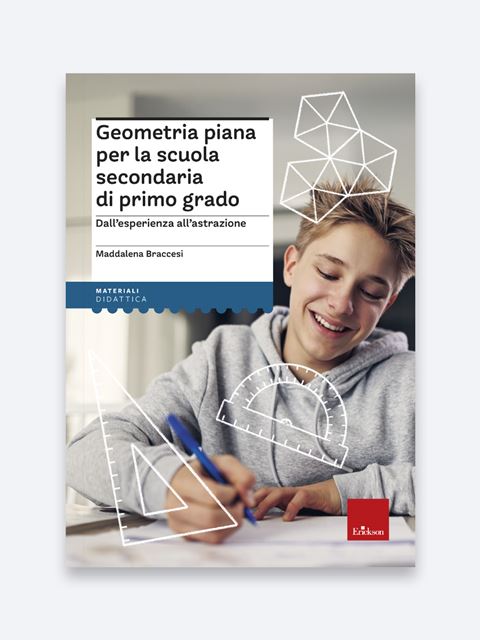
Designed for lower secondary school, this volume offers a structured, workshop-based pathway that takes geometry beyond the pages of the textbook and into direct experience. Four thematic chapters guide students in exploring plane figures through hands-on activities, constructions, guided reflections and mathematical games, stimulating logical thinking and creativity.
The book draws on years of classroom experimentation and teacher training, adopting a cooperative and inclusive approach in which each proposal encourages active participation and values different learning styles. The method follows a STEAM (Science, Technology, Engineering, Arts, Mathematics) approach, integrating logical reasoning and hands-on work, and turning mathematics into a field for personal and shared exploration.
Introduction
Bibliography
CHAPTER 1 – ANGLES, TRIANGLES AND OTHER POLYGONS
Pathway 1A – Towards the study of plane figures
Activity 1 – Faces of polyhedra
Activity 2 – Pull-up solids
Activity 3 – Nets and developments of the cube
Activity 4 – Plane sections of solids
Pathway 1B – Polygons: relationships between angles
Activity 1 – Angles, units of measurement and estimation tools
Activity 2 – The sum of the interior angles of a triangle
Activity 3 – The sum of the interior angles of a polygon
Activity 4 – The sum of the exterior angles of a polygon
Pathway 1C – Polygons: relationships between sides and other segments
Activity 1 – The triangle inequality
Activity 2 – Number of sides and number of diagonals
Activity 3 – Diagonals and stars
Activity 4 – Notable points of triangles
Pathway 1D – Watch your words!
Activity 1 – Triangles and their characteristics
Activity 2 – Different types of parallelograms
Activity 3 – The set of quadrilaterals
Activity 4 – Equilateral, equiangular or regular?
Activity 5 – Regular sections of the cube
Activity 6 – The mysterious figure
CHAPTER 2 – MIRRORS, MOSAICS AND FRIEZES: FROM PERIODIC DRAWINGS TO ISOMETRIES
Pathway 2A – Constructing and analysing mosaics
Activity 1 – The hall of mirrors and reflection symmetries
Activity 2 – A criterion for classifying mosaics: rotational symmetries
Activity 3 – From the search for the minimum module to fundamental isometries
Activity 4 – Tiles and pavements: physical models
Activity 5 – Tiles and pavements: graphic models
Pathway 2B – Symmetries in friezes
Activity 1 – Symmetric or palindromic?
Activity 2 – Friezes and their classification
Activity 3 – One frieze for each type
Activity 4 – Create your own frieze!
CHAPTER 3 – AREA AND PERIMETER
Pathway 3A – Perimeters, areas and optimisation problems
Activity 1 – Boundary and surface of a plane figure: Dido’s problem
Activity 2 – Perimeter and area of figures made up of squares
Activity 3 – Isoperimetric rectangles and equivalent rectangles
Activity 4 – Composing and decomposing: from the area of a rectangle to the areas of other polygons
Activity 5 – Regular polygons and the circle: expressing relationships in algebraic form
Pathway 3B – Fold, cut and draw the Pythagorean theorem
Activity 1 – An origami tiling
Activity 2 – The Pythagorean floor
Activity 3 – Origami Pythagoras – isosceles right triangle
Activity 4 – Tangram Pythagoras – isosceles right triangle
Activity 5 – General case: Perigal’s proof
Activity 6 – General case: Liu Hui’s proof
Activity 7 – Pythagorean trees
Activity 8 – The spiral of irrational numbers
Pathway 3C – Geometric puzzles: the Tangram and the Stomachion
Activity 1 – A box for the Tangram
Activity 2 – Constructing the Tangram
Activity 3 – Tangram pieces
Activity 4 – Composing polygons
Activity 5 – Reproducing figures: a challenge
Activity 6 – Lengths and perimeters – algebraic expressions
Activity 7 – Fractions and areas
Activity 8 – Tangram and optimisation
Activity 9 – The Stomachion
Activity 10 – Constructing the Stomachion
Activity 11 – Stomachion pieces
Activity 12 – Composing polygons and reproducing figures
Activity 13 – Areas and perimeters
Pathway 3D – The circumference, the circle and the number pi (π)
Activity 1 – Ratio between the circumference and the diameter
Activity 2 – π: approximate values
Activity 3 – Ratio between the area of a circle and the area of the square on the radius
Activity 4 – The formula for calculating the area of a circle
Activity 5 – Figures with circular elements: relationships between areas
CHAPTER 4 – SHEETS, RATIOS AND SIMILARITY
Pathway 4A – Similarity with An sheets
Activity 1 – Which rectangles are similar?
Activity 2 – An-format sheets and similarity
Activity 3 – Ratios between the areas of similar rectangles
Activity 4 – The origami tree – similar pentagons
Activity 5 – The spiral of An triangles
Pathway 4B – Special rectangles
Activity 1 – The golden ratio
Activity 2 – Golden polygons
Activity 3 – The golden rectangle in a square sheet
Activity 4 – The golden rectangle in an A4 sheet
Activity 5 – The “An” rectangle and the golden rectangle: a shared characteristic
Activity 6 – From the A4 sheet to the silver rectangle
Activity 7 – The silver rectangle and the regular octagon
Activity 8 – The Fibonacci spiral and the golden rectangle