EN
EN PT
PT

 EN
EN
 PT
PT
Planning spaces and activities at nursery school
Product: Book
Trim size in cm: 17x24cm
Pages: 160
ISBN: 9788859029304
Publication date: 01/02/2023
Suitable for: Pre-nursery (ages 0-3)
REQUEST A SAMPLE OR MORE INFORMATION
 Rights sold to:
Spain
Rights sold to:
Spain
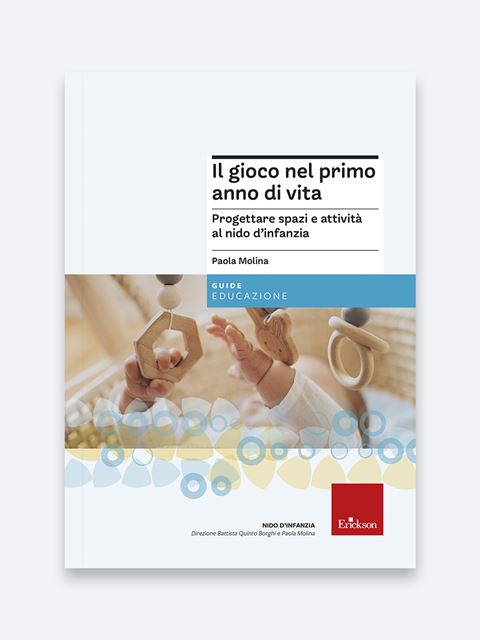
The book provides an observation tool capable of capturing the skills, especially motor skills and interaction with objects and peers, of the child during early childhood, in order to define an educational project and an environment to support his/her area of proximal development and which helps educators reflect on the play context offered in the nursery and on its adequacy.
The first part of the volume presents the main ideas on play and playing and an introduction to development in the first year of life. In the second part, the observation tool is presented, accompanied by a description of the methods of use, starting from video recording, to building the observational material as a basis for reflection on the organization of the environment and on the choices of the educational team in function with the child and his/her needs for exploration and play. Finally, some examples of use are given.
Nursery School Series
Directed by Battista Quinto Borghi and Paola Molina, the Nursery School Series offers materials and tools for reflection on the meaning of the nursery, which deepen the debate on the basic principles of education of the very young, defining the operational models starting from the founding aspects of the educational proposal: you live in the nursery, it is not a school. The nursery is a space that sees adults and children together, also providing a service for parents, not just for children.
Presentation (Sandra Dodi)
Introduction
FIRST PART
Play and the youngest children
Chapter 1
What is play?
Chapter 2
The first year of life
SECOND PART
The tools
Chapter 3
Why play observation tools are necessary
Chapter 4
Observing the baby who plays
Chapter 5
Observing the context
Chapter 6
Observing interaction
THIRD PART
Examples of using the tools
Chapter 7
In educational practice
Chapter 8
In research
Conclusion
Bibliography