EN
EN PT
PT

 EN
EN
 PT
PT
Product: Book
Trim size in cm: 29,7x42cm
ISBN: 9788859050377
Publication date: 01/09/2026
Suitable for: Nursery 1st Level (ages 3-4), Nursery 2nd Level (ages 4-5), Primary 1st level (ages 6-7)
REQUEST A SAMPLE OR MORE INFORMATION
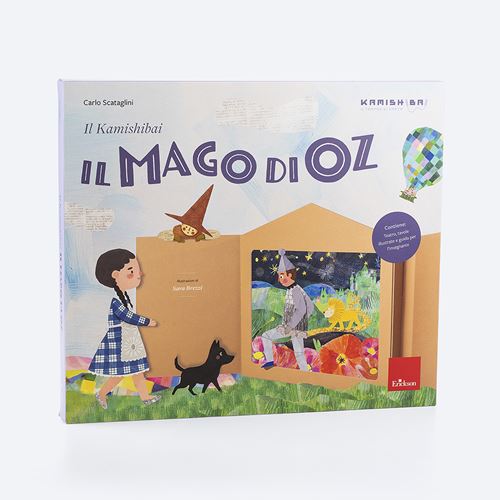
The Wizard of Oz comes to life through the Kamishibai, the traditional Japanese portable storytelling theatre. Colourful and rich in educational opportunities, it provides an engaging way to develop classroom and home-based activities, encouraging imagination, listening skills and active participation among children.
HOW TO PLAY:
An adult reads the text printed on the back of each story card while children follow the illustrations, becoming fully immersed in the story. To support emerging readers, the set also includes a simplified version of the text.
Erickson’s Kamishibai
Kamishibai, the traditional “paper theater” of ancient Japan, is a form of narration that combines the dramatization of the narrator with suggestive images. Children use their imagination while the adult interprets the text printed on the back of the illustrated cards resulting in a performance that involves and frees the imagination. It is an experience that can be considered complete in itself, but it can also be used as an introduction or a complement for educational workshops with children aged 3-6. Erickson’s kamishibai has been specially designed for use in schools, especially in early childhood, and its light structure makes it easy to use and transport.
• 14 illustrated story cards
• Extra cards: a neutral background and characters to cut out
• Teacher’s guide: advice on methodology, numerous activities and workshops to carry out with Kamishibai to make the most of its potential.
Narrate and reenact stories using a paper theatre
The kamishibai is a small paper theatre that turns every reading into a captivating performance, full of emotion and wonder. Originating in Japan in the 12th century, kamishibai is now used both in schools and at home to encourage listening, language development, creativity, and active participation. As the illustrated story cards slide into view and the narrator’s voice leads the tale, children are immersed in an experience that uniquely combines images and words.
The Erickson kamishibai is designed to fit naturally into the school routine: it can be used for reading aloud, inventing stories, dramatising, and letting the imagination run free.
USES FOR KAMISHIBAI
Listening to stories, as well as re-telling them and inventing new ones, is fundamental for children’s cognitive and emotional growth because it allows them to know and understand the world, to become aware of their own inner self and that of others. With Erickson’s kamishibai, there is also a direct connection to didactics, as the contents of the stories are carefully selected based on the didactic objectives of kindergarten and primary school.
Kamishibai is particularly useful for:
HOW DOES IT WORK?

First, the theatre is placed on the table and the boards are inserted in order of appearance, from 1 to 14.

The narration proceeds by scrolling the sheets from front to back, removing the front board and inserting it behind all the others: on the front the illustrations capture the attention of the children, on the back the adult reads the story.

On the back of each board, next to the text, there is a thumbnail of the image that the viewers see and a QR-code for accessing sound effects and music.
NARRATION SUGGESTIONS
Before: It is very important to make the narrative magical and engaging, creating a stimulating atmosphere suitable for children: setting up the lights, taking care of the sound accompaniment, arranging pillows and rugs on the floor, etc.
During: The stories chosen for the kamishibai have a didactic-educational purpose and allow the teacher to link the narration to numerous activities on the five senses (sight, hearing, smell, touch and taste) to expose the children to a multi-sensory experience where they can learn how to know and manage their emotions.
After: It is possible to reflect on the themes, context, and characters encountered during the narration. By inviting children to rework the story of Marilù and recite new narratives, they will give free rein to their imaginations.

WATCH THE PRESENTATION VIDEO BY CARLO SCATAGLINI, AUTHOR AND TEACHER
 Press the CC button in the lower right corner of the video player to activate English subtitles
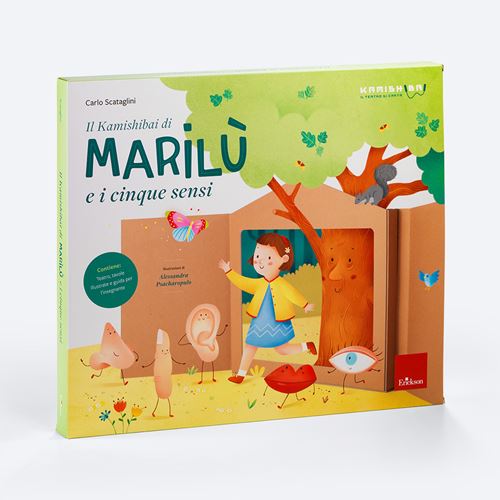
The Kamishibai of Marilù and the five senses
14 illustrated story cards tell the tale of Marilù and accompany children on a journey to discover the five senses through the art of kamishibai.
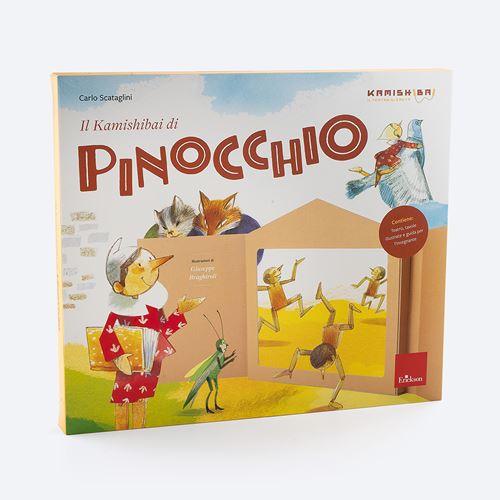
The Kamishibai of Pinocchio
14 illustrated story cards narrate the story of the world’s most famous puppet – Pinocchio – through the magical storytelling style of kamishibai.
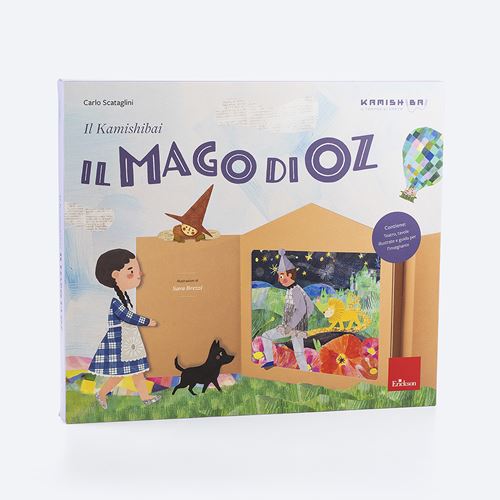
The Kamishibai – The Wizard of Oz
14 illustrated story cards tell the famous story of The Wizard of Oz, and guides children on a journey to discover the fantasy, listening and active participation through the art of kamishibai.